Background

Thursday, January 12, 2012

Schon Ausgerutscht


So, Frohes Neues Jahr! That’s one thing I learned here last year, it’s ok to say “Happy new year,” even a few weeks after the 1st. I think the unspoken rule is, if you haven’t seen that person yet then it’s still ok to greet them as if it were the 2nd. I feel the statute of limitations on this greeting is until late January.

The holidays were great and I enjoyed a nice little homecation. I had a week and a half without classes and I took the time to not do work and relax. At the moment I am entertaining a fellow Californian. Since I've lived here I decided having someone from the states over is always a nice reason to take the train to Paris, since it's about two and a half hours away. 

It was my third time in Paris so I felt a little more comfortable than the second (since my first time I was with people who knew the ins and outs of the city). I feel like the hardest part for me is figuring out the metro network. Every trip (I mean trip within the city, moving from one point of interest to the next) becomes about coordinating stations and making connections, at least for someone like myself who is hopeless at reading maps and prone to losing my way if I have to walk more than a few minutes. Incidentally, I was there with my mom last year in April and was forced to figure out the metro to get us around. I did just fine with no blunders if my memory serves correct. We could see Sacré-Cœur from our hotel balcony so I thought, “well I could get us there.” Armed with a set of instructions from the hotel reception, which I obviously forgot upon exiting, and a crude tourist map I set off in the direction of the basilica. After taking a few side streets that probably (actually definitely not necessary) and a little wander later, we arrived after about twenty minutes or so. 

This time around, I actually found the metro stop for the Sacré-Cœur and had to walk only a few minutes. I remembered the hotel where I had stayed was also a short walk from the Moulin Rouge. So atop the hill I suggested to Jacquelynn that we try walking there rather than getting on the metro. I was a bit nervous I’d get us lost but actually we were only minutes away from the hotel, ha. 

The next day I decided The Louvre would be a good choice. It was a Monday so I thought that would mean it would be less busy. I found the key was getting there early, just after opening time, before all the tour groups get there. Before we entered the museum, we felt a few pictures of I M Pei’s pyramid were in order. There were some other tourists who were there as well, and they made one of those jumping pictures where you look airborn after jumping off something/springing in the air. I will be the first to admit I have a terrible center of gravity and am not by any stretch of the imagination nimble or otherwise aerobatic, but for some reason I thought I'd try it. I got a good amount of air, but actually more than I bargained for. I ended up landing on my heel with most of my body weight. It hurt pretty bad. Too bad it was not even 10 and I had an entire day of city walking planned. I continued to lead a mini tour de force through the city, hitting up Notre Dame and the tower before my inevitable surrender before we could get to the arc. I made it back to my friend's place for a nice home cooked meal and a bit of rest before the trip back.

(view from the hotel balcony in April)


 (Jump at own risk)

 Really not as exciting when compared to some of the other works, but here's a picture of it (Photo credit: Jax!)


The next day I shuffled to the train station, with Jacquelynn’s help carrying my bag,
and made it back home. I went to the doctor today and the good news is that nothing’s broken, just a bruised ego and an uncomfortable foot for a few more days. I learned that I can do just fine checking in to a hospital (answering questions is no problem), but taking directions is still iffy. I had to have Röntgenaufnahme (X rays) and the technician was trying to tell me what to do because she didn't want to hurt my foot. I realized there are so many body parts and verbs for movement that I still just don’t know! It’s ironic that I didn’t heed one students departing words, “Guten Rutsch! Aber nicht so viel rutschen! Nicht ausrutschen!” Looks like I didn’t make it into 2012 as gracefully as possible.

Tuesday, December 27, 2011

Germans are funny part 2


In the hours leading up to the Christmas Eve festivities I caught some of the news for the day. A famous actor named Johannes Heesters died at the age of 108. The man’s career is impressive, spanning decades of theater, film and music. He was even appearing in films and plays earlier this year before his passing on Christmas Eve.

Later that evening at home I was introduced to a classic comedy movie from 1985 titled Otto der Film. I must admit that though my language skills are adequate, watching TV and especially movies is still a formidable task. I’ve found particularly with comedies that a lot of the humor lies in word play and regional expressions, which I still struggle to grasp in the moment (imagine those situations where you catch yourself laughing at a joke you’d heard half an hour ago). Most of the time, I manage to get a few of the puns and enjoy some of the witty banter but by and large a lot of the dialogue kind of escapes me.

This particular film was however easier to follow. A lot of its humor was in physical comedy. True to its time, it was a pretty safe laugh to have your protagonist accidentally light something on fire or nearly escape a comical death. In addition to these slapstick situations, this film had an almost annoyingly entertaining lead character, Otto (Waalkes), a film and music star whose career continues to such contemporary works as voicing the sloth in the German Ice Age films. Otto, a young man from a small town setting, comes to the big city (Hamburg) to make his fortune. Most of all he is engaged with two problems: How can he impress Silvia, a rich young girl whose life he accidentally saves, and where does he get 9876,50 Deutsche Marks to pay off a loan shark he struck a dubious deal with to get his start up funds? 

Incidentally, the aforementioned Johannes Heesters even has a cameo in this film. After saving the life of Silvia, Otto meets her parents. Obviously his eccentric nature is a clear juxtaposition to Silvia’s privileged upbringing, and nothing her stuffy mother approves of in comparison to the Brazilian suitor Ernesto. As a thank you, Silvia’s mother gives Otto an old bottle of wine. After singing the mother to sleep with a comedic song about sheep, he thought briefly about stealing a piece of jewelry to cover his debt, but a recurring theme in the film, Otto’s moral dialogue of good guy on one shoulder bad one on the other, talked him out of it.

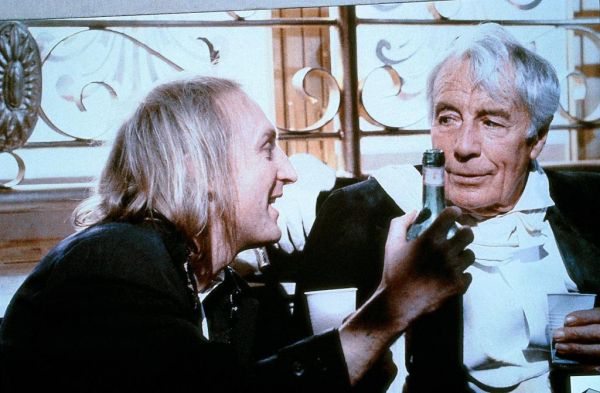
Later in the film, Otto, after throwing back a few, crashes a classy dinner at the Crème de la Crème, where he hopes to profess his love for Silvia in front of the high society guests. Naturally, this plan goes awry and Otto ends up being thrown out of the restaurant. In a fit of anger, Otto rifles through the trunk of his shabby car to find something to throw and comes across the bottle of wine. Cue Johannes Heesters, who stops Otto mid-throw to urge him not to waste a bottle of wine. The two then open the bottle (Johannes obviously had a cork screw and paper cups), and toasted. After a few sips, and a bit of dialogue, Johannes begins to comment on the quality of this wine. He speculates it’s from 1902 or perhaps even 1901. He then checks the label to find it’s an 1899 bottle of wine. He rejoices in how lucky he is to savor such a treasure, Otto seemingly unimpressed with the quality shrugs and continues to slurp. The man then goes on to comment on how much a bottle like this one brought in at a recent auction. Can you guess the amount? Spoiler alert, it’s exactly how much he owes.


Not only physical comedy and irony, this film also boasts a bit of parodying, as well as a nod to classic American cinema (in this humble observer’s opinion). After having a meaty dinner at a local Greek restaurant with his beloved Silvia, there is a sudden rainstorm. A la Gene Kelly, Otto opens his umbrella and does a charming dance in the rain, leaving Silvia cold and wet. After his little dance, they begin walking in the direction of a cemetery when suddenly, out of the graves bodies start moving. Keep in mind this is 1985, a few years after Michael Jackson’s, “Thriller.” All of a sudden there are a group of men, whom I later found out were dressed as a German folk singer Heino singing one of his songs all in a zombie like robot motion.  I only got one level of the humor, as I could clearly tell it was a take on Thriller, but had to have the folk singer part explained to me.
(please excuse the second screenshot, I felt it was necessary, despite the poor quality, to illustrate what I consider to be the tribute)


Smash cut to the end, Otto ends up dressed as a flight attendant on a plane with Silvia, her mother, Ernesto, and a bunch of Karneval clad party goers on their way to Rio. Aboard are two bank robbers who knocked out the pilot and co-pilot and forced Otto to fly. He lands on what he thinks is Cuba but is actually an aircraft carrier. Turns out, Ernesto wasn’t as rich as he said he was and Silvia and Otto end up together. 


It was worth a laugh and at least I'm to the point where I can follow a movie! Here is a video clip, he could certainly have lent some noise to the Stomp crew.


Sunday, December 25, 2011

Word of the week: Schöne Feiertage und einen guten Rutsch!

Schöne Feiertage/Frohes Fest/Frohe Weihnachten und einen guten Rutsch! : Happy Holidays/Merry Christmas and a happy new year!


Last night was kind of the main event here. On Heiligabend (Christmas Eve) we traded gifts (Bescherung) and had a lovely meal. In fact here, the 25th and 26th are both part of the Christmas holidays. I've had students and colleagues explain it to me as somewhat necessary as people usually have to visit more than one set of family members and therefore it's easier when there are two holidays for that. This year Christmas happens to fall on a Sunday, which is kind of unfortunate for some who cannot take the week following the holiday off. However, as a teacher I tend to get breaks when students get breaks, so that's kind of nice.

The last few weeks have been relatively busy for me. I am teaching a couple classes at a university. The semester ends in February and I have to prepare the final exams and I've been pretty occupied with that, in addition to other lessons. But as of Friday I submitted everything and now reserve the right to chill for a week until after the new year! At the end of each lesson I had (the last lesson before the break I mean), most would use this expression, "Schöne Feiertage und einen guten Rutsch!" or at least ask me what the equivalent is in English.

If you were to translate literally, guten Rutsch is like have a nice slip, from the verb rutschen (slip, skid). The intended meaning of the expression is that when someone wishes you einen guten Rutsch, they hope that you come safely and happily into the new year. Some claim the word choice of this common holiday expression has to do with the weather, given that in this time of year it can be very cold and icy, hence an increased potential for slipping. So in this case you wish someone a nice slip, one that brings them well into the new year. Others claim the etymology lie
in the wishes of the Jewish New Year Rosch ha-Schana (Hebrew: Head of year) by Yiddish-speaking Jews as "Gut Rosch," which over time was borrowed into German.


In any case, it's a way of wishing a happy new year, which I do to you! Below are just a few pictures from the last week. Enjoy your holiday!


Last day of the Christmas market


Saturday, December 10, 2011

Crowd swimming in the Christmas Market

You knew it was coming, a Christmas market post. Living in Aachen it’s virtually impossible to avoid. In Germany alone there are thousands of Weihnachtsmärkte (Christmas markets), from the larger cities with their respectively larger markets (Munich, Berlin, Cologne), to even the smallest of villages will have some kind of Christmas related event (most commonly in the form of a market). The opening of Christmas markets is somehow connected to Advent; Aachen’s market opened a week before the first day of Advent, and runs until the 23rd of December. Not all markets run that long, or are even open from morning until night.

It’s no wonder Aachen’s market is considered one of the larger. We’re quite close to the border of France, Belgium and the Netherlands; it’s also a popular destination for British people as well. There are of course tourists from all over the world in addition; bringing estimates to 1,5 million visitors per season. Walking around you hear all kinds of languages, and announcements made over the loudspeaker for security are in German, French, English and Dutch. During the day it’s packed with school kids and tourists, and at night it fills further when even the locals come out to meet up with family, friends and co-workers.


With more than 120 Stände (stalls), you can quench any thirst or satiate any holiday cravings. There’s the standard Glühwein, or Lumomba (hot chocolate served with amaretto or Bailey’s). There’s Eierpunsch (I guess something similar to eggnog), there’s even Jägertee (tea served with Jägermeister). If you’re feeling noshy (fun fact: nosh is another German loan word from “noschen” the verb that means the same), there’s no shortage of savory and sweet, whether it’s Pommes frittes (fries), pizza, fish or my personal favorite Rostbratwurst, or Lebkuchen (kind of spicy cake), Pfannkuchen (pancakes filled with your choice of fruit), Crêpes and Waffels, to even cotton candy, licorice, chocolate without end and Gebrannte Mandeln (candied, toasted almonds), you’ll find something to enjoy that quickly becomes a holiday ritual, as reflexive as wearing your winter coat.


If you’re not hungry (or full), you can spend even more time cruising around purchasing a range of decorations and gifts, a lot of which are made locally or at least in Germany. I personally enjoy the woodwork and lace. The air is filled with the sound of a humming crowd sometimes accompanied by a choir singing or musicians playing in the streets, and pathways are warmly lit and trimmed with Christmas plants and almost every shop has Christmas decorations. It is indeed a sight to behold.


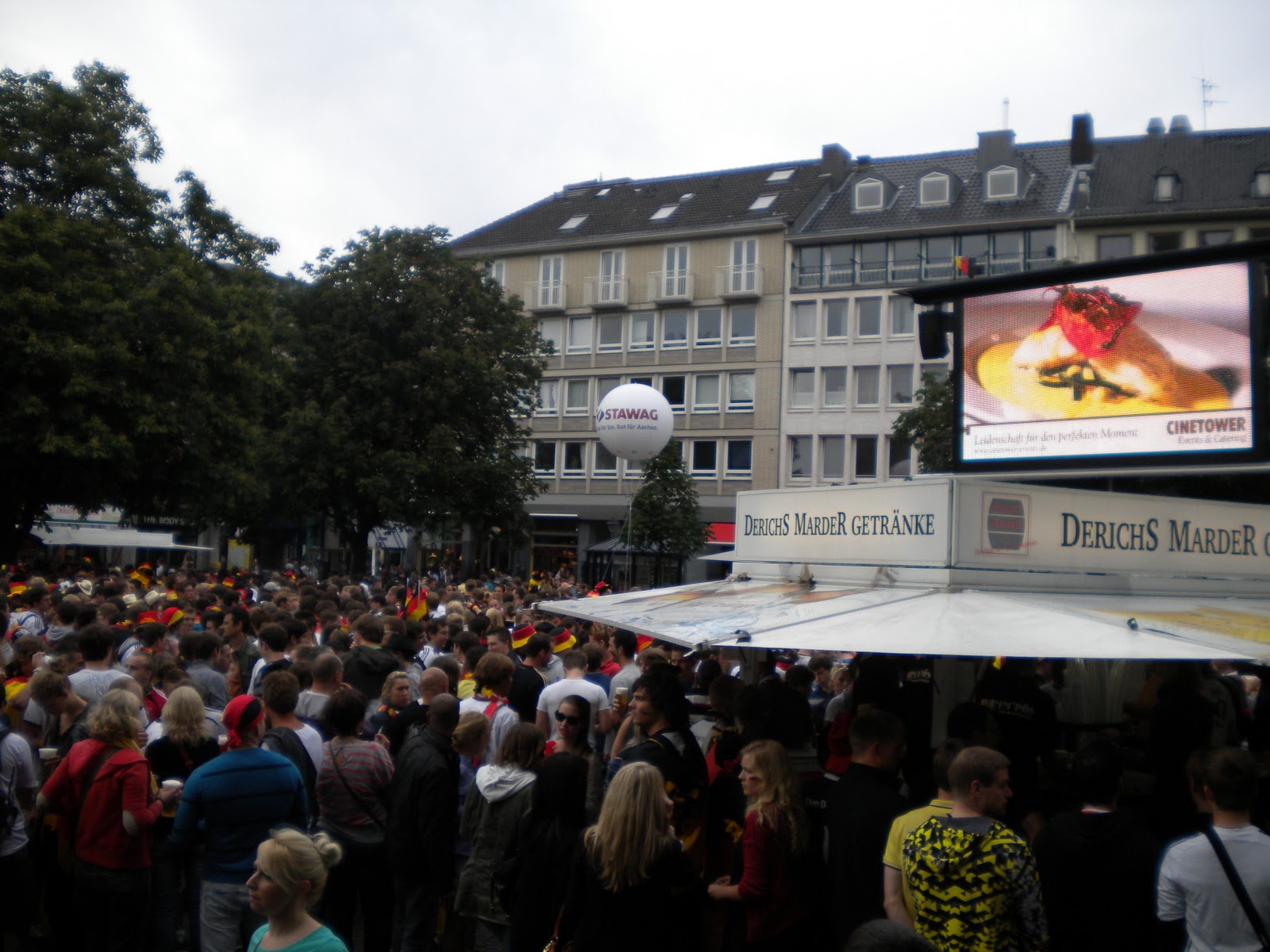
Since Christmas markets are such beloved holiday "musts," it’s almost always packed. If you go on a Friday night for example, it’s a sea of people bustling around. This unavoidable mass (similar in size to public viewing broadcasts of World Cup games) led me to fine tune a skill I’d like to coin as crowd swimming. You’re no doubt familiar with the concept of crowd surfing, which you would do at some kind of performance, where you trust in the sea of people to pass you around much as an ocean moves a surfer on their board. It would obviously be a bit awkward if you tried to crowd surf at a Christmas market, as the crowd isn’t compact and stationary as it is at a concert, but rather alive and flowing much like a body of water. Instead of being transported via the surface water, it becomes necessary to use currents to your advantage in getting you from one stand to the next. You have to hone a kind of tunnel vision, where you know what your desired destination point is, and you can kind of focus in on it, enabling you to see the most direct route and get through the current obstacles as smoothly as possible. Notice I said “current,” as the obstacles are ever changing, one second it’s an elderly couple, the next it’s a pack of school kids, then it’s a crowd of university students (who may or may not be on their way to class/exams), suddenly it’s a mom with her baby and toddler in toe (adorably rugged up for the nippy temperatures), and people snapping pictures at every angle. It’s properly full of people.
So I see the movement therein as similar to this water metaphor in crowd surfing, only instead instead of letting yourself be transported, you’re moving around whatever is in front of you at the moment always with your end point in mind, swooping to the left to allow space for a wheelchair, perhaps a quick pivot to give way to the couple holding hands always looking over your shoulder to locate your partner lest you suddenly find yourself missing your other half and have to “plant,” yourself until you make visual contact again. (First is from a 2010 World Cup public viewing on the market place)


 Another physical capability that must be trained in such crowded events is the ability to transport drinks for a group without spilling. The aforementioned Glühwein is often served in charming little boots. Some stands serve in conventional round mugs, but enough serve the magically warming beverage in these festive boots. Imagine this, you and some friends are meeting up at the market, once everyone has arrived it becomes necessary to purchase the first round. Depending on the skill of the procurer, it may be a 1 or 2 person operation. Once you get to the actual bar, and order your 6 servings, then you have to get back to your posse through the swarm of thirsty visitors that has amassed since you’ve been waiting. You learn to use every centimeter of your foot as you carefully navigate through the huddle (bonus points if there’s snow on the ground). It’s also not unlike when you were a kid and would pour yourself a healthy bowl of cereal filled with milk, those steps from the counter to where you were going to eat were careful and precise. Such is the dexterity required for retrieving a round of this warm treat, keep in mind spilling one creates some kind domino effect where the others tremble sending streams down your fingers, then you’re left with the unfortunate sticky hands/clothes and you may have slopped on another person, a real Christmas market fowl.


(Hexenhof, a crowded Glühwein vendor). Despite the crowds, I still find the Christmas market to be a wonderful place. I enjoy it each year just as much as the last.